
|
Pivot center
In another thread, Yoda stated that a golfer needs a i) pivot center and that the pivot center needs to be centralised between the feet.
Of all HKs' ideas I have never understood why there needs to be a pivot center for the swinging arms/clubshaft. I can understand a grandfather clock having a pivot center located at the fulcrum of the pendulum because i) the length/radius of the pendulum arm is constant and ii) the low point of the pendular arc is constant. However, golfers don't have a consistent ball position and/or a consistent low point - relative to the center of their stance. Also, the length (radius) of the left arm/clubshaft swinging structure varies continuously during the downswing. Also, the fulcrum (left shoulder socket) of the left arm/clubshaft structure moves in space continuously and has a variable distance from the required low point (a set number of inches ahead of the ball). Also, although the low point of the swing is roughly opposite the left shoulder socket area, the left arm/clubshaft length/radius is not necessarily at its greatest value at that time point. The left arm/clubshaft's length/radius is at its greatest value when the left arm is maximally straight and the clubshaft is maximally straight-in-line with the left arm, and that occurs at the end of the followthrough. Maybe that is why HK didn't state that a stationary head is an imperative, but more imprecisely classified it as an essential requirement. Rhythm and balance are also imprecise concepts that are classified as essential requirements. To make any further discussion interesting/informative, I am including a series of photos showing the pivot center of different golfers. I drew red lines through the pivot center (defined as a point midway between the shoulders) at address. I then left the red line constant, and captured two additional images - at the end-backswing and at impact. From this swing video - http://www.youtube.com/watch?v=StKkT9sTTtQ Gary Player 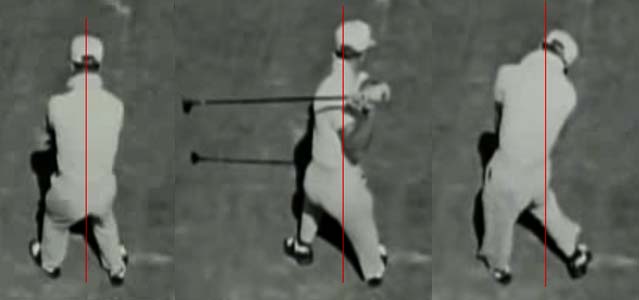 Arnold Palmer 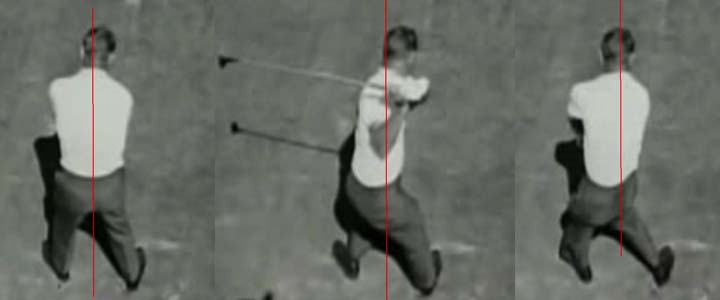 Jack Nicklaus 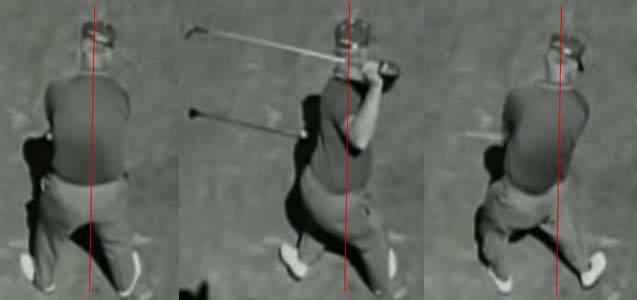 Mike Souchak 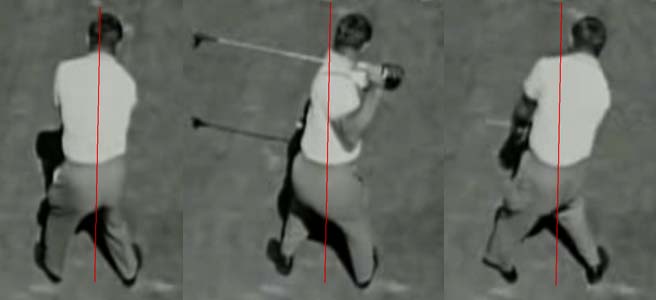 Here is another swing video that is pertinent to this discussion From this Natalie Gulbis/Paula Creamer swing video - http://www.youtube.com/watch?v=jviToMF5kYk Natalie Gulbis 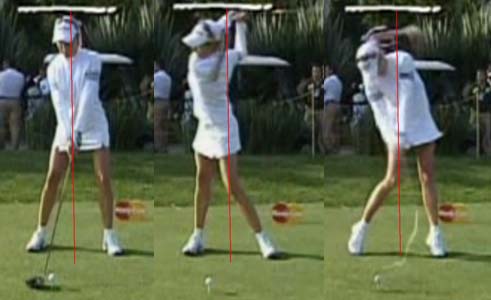 Paula Creamer 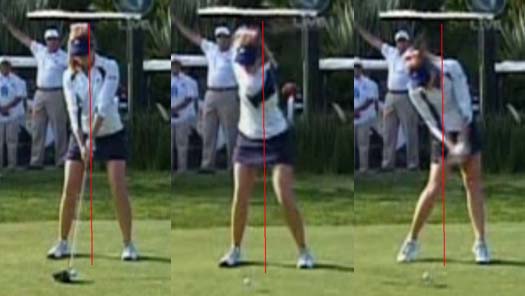 If I were considering essential requirements (and not imperatives) for a golf swing, I would consider removing "stationary head" and inserting "set distance of the left shoulder socket from the ball at impact". Jeff. |
angle of pics
I think (unless both girls play with the ball way back in the stance) that because of the angle from which the photos are taken, the pics of Creamer and Gulbis aren't very useful.
|
Even though the camera angle was not square, one can certainly see that both of the young ladies do not keep their head, or upper swing center, stationary. Check the swing video for a DTL view to see how much their heads drop. It's a staggering amount. They do not have any pivot center to their swings.
Jeff. |
???
Hmmmm...... I'll take the "Big 3" over Souchak/Gulbis/Creamer any day.
On second thought..... you know that move by Gulbis does look quite "golf-like".... I wonder if I shouldn't work on that. Jeff - can you please tell me how to go about it? Looks like it might be the way to go. |
Cometgolfer
I think that you are missing the point. I am not recommending that anybody emulate the Gulbis/Creamer approach. I only posted their swings as extreme examples of golfers who don't have a stationary head and who don't have anything resembling a pivot center in their swing, and yet they can consistently hit the ball well enough to play at a professional level. The question that it raises is what is the primary function of a i) stationary head; ii) a pivot center; and does the pivot center have to centralised between the feet throughout the swing. You are free to express your opinions on this issue. Jeff. |
Quote:
|
Seeing that nobody has posted deep thoughts on the idea of a pivot center and/or stationary head, I will post my personal opinions. Feel free to criticise them. I have been wrong many times in the past and I am willing to modify my opinions in the face of constructive criticism.
I think that the pivot plays a number of roles in a golf swing. It powers the swing via the loading and release of PA#4. It transports the intact power package assembly downplane at the start of he downswing. Finally, it forms a stable supporting structure during the release of the PA#4/2 so that a golfer can generate an on-plane clusbhaft movement (that traces the SPL) and that results in a consistent low point position. In other words, for a golfer to consistently swing and have the low point at exactly the same spot (for a particular club) requires a stable supporting pivot structure. Consider this swing video lesson by Shawn Clements. http://www.youtube.com/watch?v=tstAAWUGN6c Note how he can swing back-and-forth consistently because he has a stable pivoting structure - which he likens to a construction crane. I think that's a good analogy. A construction crane cannot be unstable/wobbly if it wants to perform its role correctly/optimally. What part of the pivoting structure plays the key role in this stable supporting structure during the downswing. I think that its the skeletal structure that runs from the C7 vertebra down the spine to the pelvis passing through the pelvis to the left foot via the braced left leg - as seen in this next photo. 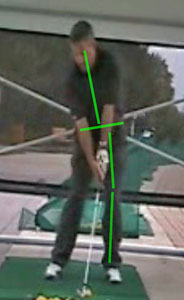 I have placed green lines to identify the key skeletal structures that allows a golfer to pivot in a stable manner. The left lower limb needs to be braced and the secondary spinal axis tilt must also be braced to keep the entire pivoting structure stable during the downswing. The head sits atop this structure and is a marker for the stability of that pivoting skeletal structure. Actually, it is acceptable for the head to drop downwards-backwards if a golfer has a large degree of secondary axis tilt as long as the base of the neck (C7 vertebra) doesn't move. That's why I can understand Homer Kelley stating that the base of the neck is equivalent to the stationary head as a marker of a stable pivot. Does the head (or C7 vertebra) have to be situated in the center of the stance for a golfer to have a stable pivoting structure. I don't think that it's a necessary requirement. Consider Shawn Clement in his one-leg drill. http://www.youtube.com/watch?v=T2FnfZlRwak He has no pivot center or any possibility of a centralised stance. However, he can swing very consistently to a consistent low point in his downswing. This composite photo shows the change in his degree of secondary axis tilt during the downswing. 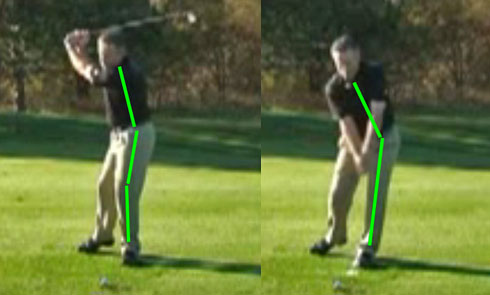 Obviously his head has to move during the downswing. However, he is still creating a stable pivoting structure that is consistently stable swing-after-swing. Also, note that his stance (with his right hip cleared way back) forces him to have a large degree of secondary axis tilt at address. However, that doesn't mean that one cannot have a stable pivot in the downswing. In other words, I think that variable degrees of rightwards tilt at address (and during the downswing) is still compatible with the concept of a stable pivoting skeletal structure. I think that the position of the base of the neck (C7 vertebra) relative to the center of the stance depends on the swing style and not the stability of the pivot. Consider Mike Bennett's swing - he is the originator of the S&T swing. http://www.youtube.com/watch?v=XgbubywoLCw His head (and C7 vertebra) remain centralised between his feet because he loads over the left leg in the backswing, and he therefore does not have any rightwards pivot shift. The same type of centralised pivot is seen in Sam Snead's swing. http://www.youtube.com/watch?v=U6Gu7n7Vnm0 Sam Snead has very a centralised swing. By contrast, Anthony Kim's head is well behind the center of his stance. http://www.youtube.com/watch?v=oqmejmw-lu4&NR=1 Note how stable/stationary his head remains during the entire downswing - despite the fact that his head is well behind the center of his stance. In other words, his head is far back because he develops more secondary axis tilt than Mike Bennett or Sam Snead. However, that doesn't mean that he is a less superb ball striker. I think that he is a superb ball-striker, who has a very stable pivoting skeletal structure. In other words, I don't think that the head (or base of the neck) has to be in the center of the stance to fulfill Homer Kelley's definitional requirement of a "stationary head" being a necessary requirement as part of the triad of essential requirements (the other two being balance and rhythm). Jeff. |
Would you want your dentist to be moving his head all around while he drilled your teeth? How about the surgeon in the operating room?
Homer was about repetitive precision - The Machine. |
mb6606
That's what I implied in the post above your post. Anthony Kim's swing is all about repetitive precision! Jeff. |
Pivot Center Q&A
Quote:
Quote:
Quote:
Quote:
Quote:
Quote:
Quote:
Quote:
Quote:
:golfcart2: |
| All times are GMT -4. The time now is 02:47 AM. |