I am very much in favor of the idea of lag existing throughout the swing system - for a pivot-driven swing.
I am only questioning the belief that the presence of lag will decrease clubhead deceleration during impact. It is my belief that the clubhead will decelerate to the same degree as a result of ball collision - whether there is lag at impact, or not (presuming the same clubhead speed at impact and the same ball-clubface contact conditions).
I also believe that lag mainly applies to the relationship between the clubshaft and the left arm, which means that the swing radius ends at the left shoulder socket. The concept of "lag" extending to the feet may be a useful idea in a pivot-driven swing, but doesn't apply to a left arm swinger.
I am very much in favor of the idea of lag existing throughout the swing system - for a pivot-driven swing.
I am only questioning the belief that the presence of lag will decrease clubhead deceleration during impact. It is my belief that the clubhead will decelerate to the same degree as a result of ball collision - whether there is lag at impact, or not (presuming the same clubhead speed at impact and the same ball-clubface contact conditions).
I also believe that lag mainly applies to the relationship between the clubshaft and the left arm, which means that the swing radius ends at the left shoulder socket. The concept of "lag" extending to the feet may be a useful idea in a pivot-driven swing, but doesn't apply to a left arm swinger.
Jeff.
What is a left arm swinger? In the book Swinging is based on the massive rotor of the pivot . . . . sounds like a "left arm swinger" is non-pivot delivery . . . . good for short shots.
Hitting or swinging . . . . you need lag in the pivot . . . . . again look at the extension in the longest hitters.
Also, how does clubhead lag at impact make the clubhead harder to decelerate during impact if clubhead speed is 100mph at the exact moment of first ball contact?
Jeff.
A rifle hung freely in the air or fixed steadily on the ground.
__________________ Yani Tseng, Go! Go! Go! Yani Tseng Did It Again! YOU load and sustain the "LAG", during which the "LAW" releases it, ideally beyond impact.
"Sustain (Yang/陽) the lag (Yin/陰)" is "the unification of Ying and Yang" (陰陽合一).
The "LAW" creates the "effect", which is the "motion" or "feel", with the "cause", which is the "intent" or "command".
"Lag" is the secret of golf, passion is the secret of life.
Think as a golfer, execute like a robot.
Rotate, twist, spin, turn. Bend the shaft.
12PB - Left arm swinging is a non-pivot-driven swing where the left arm is pulled away from the chest wall, and not blasted off the chest wall - as taught by proponents like Leslie King.
if you got lag, then you have maybe still a chance to have a "loaded" shaft helping in resisting the additionnal deceleration caused by impact of ball. Wouldnt the delofting caused by lag cause a more massive punch through the ball as more of the face is contacting the ball rather then hitting and skidding off the upper face of the club without lag?
just off the top of my head here with my comments so be gentle...lol
12PB - Left arm swinging is a non-pivot-driven swing where the left arm is pulled away from the chest wall, and not blasted off the chest wall - as taught by proponents like Leslie King.
You wrote-: "a "loaded" shaft helping in resisting the additionnal deceleration caused by impact of ball."
It is my opinion that a "loaded shaft" has no effect on the magnitude of clubhead deceleration due to ball collision. See nm golfers' post.
I agree that forward shaft lean at impact delofts the club. However, in my question - I stated that one should presume that clubhead speed, clubhead mass, and clubface conditions at impact should be the same for the three golfers. That would allow one to determine whether "clubhead lag" alone would affect the clubhead's magnitude of deceleration due to ball collision. I know of no reason why it should have any effect - compared to a clubhead that impacts the ball without lag.
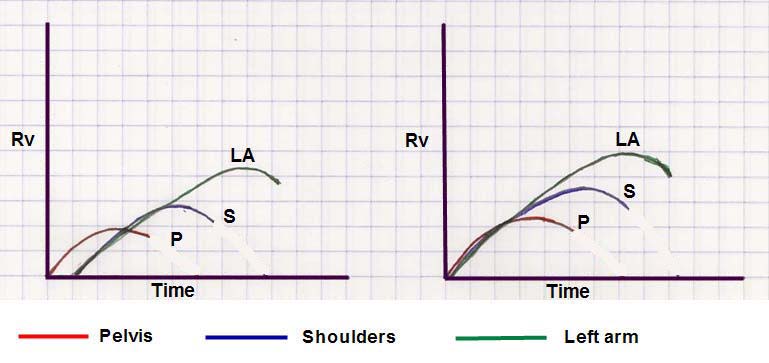
I think that "blast off" is Homer Kelley's wording. I simply think of the left arm moving away from the chest wall when the upper torso rotation slows in the mid-downswing. The rate of angular acceleration of the free-wheeling left arm remains the same, but its angular speed increases as it freewheels towards impact - because there is no impedance to the release of PA#4 and the freewheeling forward movement of the left arm.
This graph shows that the slope of the left arm graph doesn't increase when the shoulder rotation slows. However, angular speed increases.
You wrote-: "a "loaded" shaft helping in resisting the additionnal deceleration caused by impact of ball."
It is my opinion that a "loaded shaft" has no effect on the magnitude of clubhead deceleration due to ball collision. See nm golfers' post.
I agree that forward shaft lean at impact delofts the club. However, in my question - I stated that one should presume that clubhead speed, clubhead mass, and clubface conditions at impact should be the same for the three golfers. That would allow one to determine whether "clubhead lag" alone would affect the clubhead's magnitude of deceleration due to ball collision. I know of no reason why it should have any effect - compared to a clubhead that impacts the ball without lag.
Jeff.
how can you have the exact same condition of clubface with and without lag?
That's a good question. I cannot think of how that would be possible seeing that every club has an inbuilt clubface configuration that requires it to be oriented in a certain way at address/impact.
I was merely trying to eliminate confounding variables so that one could clearly establish a clear-cut causal relationship between a cause (swing radius extending to the feet) and an effect (less clubhead deceleration as a result of ball collision) presuming a "fixed" clubhead speed of 100mph at first ball contact.




 Linear Mode


