Jeff - I agree the clap position is a great way to learn the RFT, but only if combined with learning the startup swivel, hence why there are 2 EdZ drills!
The level right wrist being a huge part of understanding how the swivel and the clap blend.
Yoda - would agree that besides the turn\swivel, the clap move does show how the right arm moves?
Jeff - the other big key in my view, at least for a swingers RFT is that the elbows stay the same distance apart and point down. This helps ensure the turn is on plane during RFT, and that the loading action on PP#3 is rotated "on line". (wheel rim)
For hitter's, the key is the paddle wheel (wheel track) feel of your photos.
__________________
"Support the On Plane Swinging Force in Balance"
"we have no friends, we have no enemies, we have only teachers"
Simplicity buffs, see 5-0, 1-L, 2-0 A and B 10-2-B, 4-D, 6B-1D, 6-B-3-0-1, 6-C-1, 6-E-2
Yoda - this issue made me think of another question, which I have now added.
If a golfer has flexible wrists, and he can bend his right wrist back to 90 degrees at the end-backswing position so that he can get his right forearm angled closer to 90 degrees relative to the clubshaft at the end-backswing position, is that a disadvantage?
. . . I was wondering whether it is disadvantageous to allow the right wrist to bend back fully by the end of the backswing - thereby altering the angular relationship between the right forearm and the left arm flying wedge?
The Left Wrist is the Master Wrist, and ideally, dictates any movement (Horizontal, Perpendicular or Rotational) of the Right. The Bent Right Wrist at Impact, then, is the complement of the Flat Left Wrist, and this relationship is established no later than the Top.
Any undue Bend (Horizontal Motion) in the Right Wrist will produce a corresponding Arch in the Left. While a "small amount is advisable and useful . . . as amplification of the Clubhead Lag" (4-A-3), any exaggeration will disrupt the precision alignments of the Flying Wedges and, hence, the entire Power Package Assembly.
Jeff - the other big key in my view, at least for a swingers RFT is that the elbows stay the same distance apart and point down. This helps ensure the turn is on plane during RFT, and that the loading action on PP#3 is rotated "on line". (wheel rim)
I was wondering - if the right upper limb (via the right clap hand action and bending, but level, right wrist) keeps the clubshaft on-plane throughout the backswing, then essentially the left hand's movement in space is dictated by movement of the right hand in space. Then if the left hand's movement in space is already dictated by the right hand - and the left arm is always kept straight and the left wrist is always kept flat - then wouldn't the left arm/elbow's movement automatically occur in a certain way without having to worry about it? In other words, I am presuming that the timing of left arm/forearm clockwise rotation and left wrist upcocking would occur automatically - if the right upper limb moves correctly.
Yoda - you wrote-: "Any undue Bend (Horizontal Motion) in the Right Wrist will produce a corresponding Arch in the Left."
I can understand that situation existing at impact - when the right forearm is "fixedly" on-plane any excessive right wrist bend will produce an arched left wrist.
However, what about the top of the backswing? If the left wrist remains flat throughout the entire backswing, then wouldn't small variations in the degree of right wrist bend at the top of the backswing simply cause small variations in angling of the right forearm (relative to the left arm flying wedge) and small variations in the position of the right elbow. Would that be consequential in terms of swing mechanics?
You write-: "I used to turn the shoulders and extend both arms , long and low, with the triangle maintained."
When you state "extend both arms" I think that it correctly describes the mental picture that many golfers have in their mind when they think of the one piece takeaway. However, as Yoda accurately demonstrated in his DVD lesson, the right forearm at address must be held in a certain manner with respect to the left arm, so that the right elbow can start to fold and the right forearm can start to fan (as if performing a right clap hand action) very soon after the right forearm takeaway commences. The main purpose of the takeaway is to simply carry one's hands (and clubshaft) to the "correct" end-backswing position where the left arm flying wedge and right arm flying wedge are correctly aligned (and the entire power package assembly is correctly loaded).
Standing stiffly with extended arms leads to all sorts of incorrect backswing actions - like this frequently performed one piece takeaway action that leads to reverse pivoting.
Jeff.
Yes I used to do all of these things. My hair was a little longer back in the 70's though. No quite so heavy. More of a plaid to the pants, visor. Wilson Staff tour blades, white Jones carry bag, Wilson Pro Staff ball, footjoys with the kilty tongues. Maybe I should dig up a photo.
This swing gave me nice tour of the left side of every golf course.
Jeff - the other big key in my view, at least for a swingers RFT is that the elbows stay the same distance apart and point down. This helps ensure the turn is on plane during RFT, and that the loading action on PP#3 is rotated "on line". (wheel rim)
I was wondering - if the right upper limb (via the right clap hand action and bending, but level, right wrist) keeps the clubshaft on-plane throughout the backswing, then essentially the left hand's movement in space is dictated by movement of the right hand in space. Then if the left hand's movement in space is already dictated by the right hand - and the left arm is always kept straight and the left wrist is always kept flat - then wouldn't the left arm/elbow's movement automatically occur in a certain way without having to worry about it? In other words, I am presuming that the timing of left arm/forearm clockwise rotation and left wrist upcocking would occur automatically - if the right upper limb moves correctly.
Jeff.
Yep, assuming that level right wrist, the flying wedges will stay in place, and the rotation will happen properly, but the rest of the machine needs to react to that move (zone 1), or you'd end up off plane.
__________________
"Support the On Plane Swinging Force in Balance"
"we have no friends, we have no enemies, we have only teachers"
Simplicity buffs, see 5-0, 1-L, 2-0 A and B 10-2-B, 4-D, 6B-1D, 6-B-3-0-1, 6-C-1, 6-E-2
Yoda - you wrote-: "Any undue Bend (Horizontal Motion) in the Right Wrist will produce a corresponding Arch in the Left."
I can understand that situation existing at impact - when the right forearm is "fixedly" on-plane any excessive right wrist bend will produce an arched left wrist.
However, what about the top of the backswing? If the left wrist remains flat throughout the entire backswing, then wouldn't small variations in the degree of right wrist bend at the top of the backswing simply cause small variations in angling of the right forearm (relative to the left arm flying wedge) and small variations in the position of the right elbow. Would that be consequential in terms of swing mechanics?
Jeff.
The reason that clubface control is best kept in the left hand. (bold above).
__________________
"Support the On Plane Swinging Force in Balance"
"we have no friends, we have no enemies, we have only teachers"
Simplicity buffs, see 5-0, 1-L, 2-0 A and B 10-2-B, 4-D, 6B-1D, 6-B-3-0-1, 6-C-1, 6-E-2
The young man on my left was (and is) one of the staff professionals. As you can see from his racquet's closed position, he didn't quite get it at first. But he soon did, and in the last couple of years has penned several authoritative articles for a major golf magazine.
That's what Alignment Golf, competent teaching and 'passing the torch' is all about.
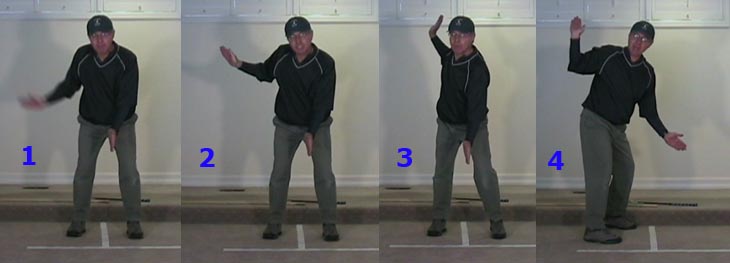
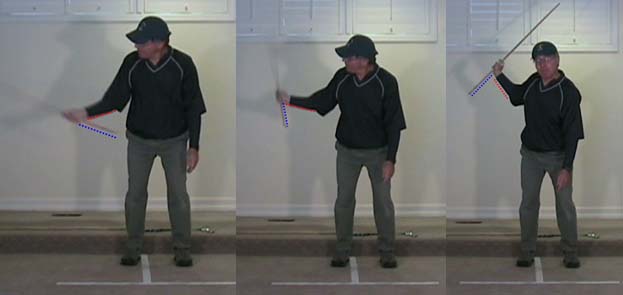
As I stated in another post, I am writing a review paper for my personal website and that composite photograph of capture images from a swing video is used to demonstrate only the first learning action - learning to execute a right clap hand motion, which only trains a golfer to understand how the right forearm and right elbow should move in the backswing (and not the right wrist). The second learning action re: the right upper limb requires learning how to bend the right wrist without allowing the right wrist to upcock - while performing the right clap hand action. That allows the right palm (and clubshaft) to remain on-plane during the backswing.
I am demonstrating that point here.
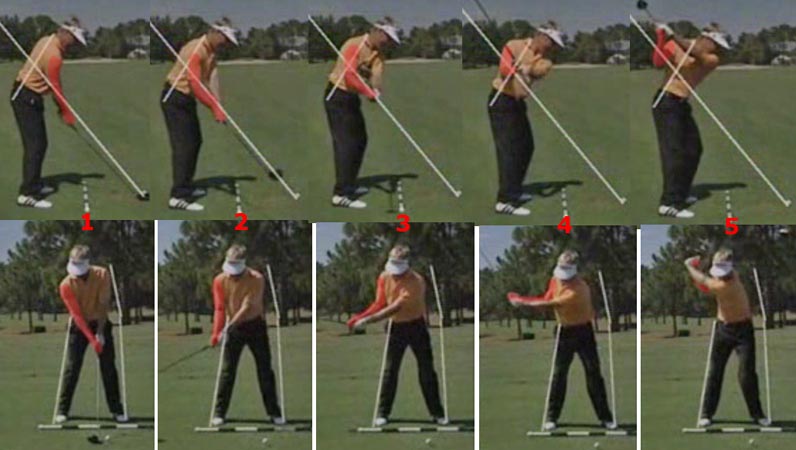
Stuart Appleby is doing a better job of demonstrating that action here.




 Linear Mode


