English is not my native language. I know the word stubborn has a negative connotation but I could not find another better word at the time. The nagativeness is not intended at all. I have read and followed the work in your website and you have all my respect. Insistence is probably a better word but may not be sufficiently colorful.
I have no problem with Yodasluke backswing for the sweet spot to be off the sweetspot plane for it is during a low energy stage. Yodasluke's plane maintenance is amazing to me and I will try to copy that in my never-ending swing revision.
On the downswing, the clubhead behaves exactly as predicted by Newton's Laws.
What I take from the swing is that at the vicinity of impact, the center of the centripetal pull or the center of your so called instantaneous curvature lies near pp#4 that is Yodasluke in counterbalancing the enormous dynamic weight of the clubhead with his torso or the whole body-- he must. If that is the case then, I have no qualm for pp#2 not on the sweetspot plane.
Forget windmills how bout tilting at trees, they being more common
Originally Posted by Yoda
Jeff,
You don't swing the hosel.
You swing the Clubhead. More specifically, the Clubhead's Sweetspot.
Period.
Stop wasting everybody's time. Your talents are better applied elsewhere.
Give this one a rest.
I'd like to second that.
How can such an intelligent man have so much trouble understanding the many, at times all most spoon fed, explanations of things on the other side of HIS debate points? An intentional deaf ear perhaps?
Jeff I actually like your debates but enough is enough. The juice from this fruit is long since gone.
The concept of "who" is tilting at windmills is a personal opinion.
Telling a person that he must not express his opinion because "enough is enough" is equivalent to censorship.
I don't censor anybody in this forum as long as they express their opinions decorously in their post. I expect to be treated in a like manner.
I agree with Yoda when he states that a golfer swings the clubhead. I will even partially accept the idea that he specifically swings the sweetspot of the clubhead. However, where I differ from the majority viewpoint is that I believe that a golfer must swing the clubhead along the clubshaft plane, and not sweetspot plane 2, in order to get the sole of the club to be parallel to the ground, and along the surface of the ground, at impact. Yodas Luke's demonstration with a big club provides experimental proof that supports my belief.
In the backswing, he took his clubshaft up the clubshaft plane (not sweetspot plane 2) and during the downswing he took his clubshaft down the clubshaft plane (and not the sweetspot 2 plane). From its address position on the sweetspot plane to its end-backswing position on the clubshaft plane, the sweetspot rotated away from sweetspot plane 2 to get to the clubshaft plane by the end of his backswing. From the delivery position to impact, the sweetspot rotated away from the clubshaft plane to get to the sweetspot plane 2 by impact.
This exactly what I predicted when I wrote in post #165 that a golfer would always have to swing his clubshaft along the clubshaft plane, but he would have to make an accomodation for a greater hosel-sweetspot distance not by altering his on-plane swing (as he would perform it with a clubshaft that lacked a clubhead), but by simply standing the appropriate distance away from the ball.
In other words, I believe that the experimental evidence from Yodas Luke's demonstration swing with a big club supports my belief that the sweetspot rotates away from, and to, the clubshaft plane - and that the hosel doesn't rotate away from, and to, the sweetspot plane.
You are free to disagree with me, and harbor a contrary belief, but you have no "right" to attempt to censor my opinion (by stating "enough is enough") because my opinion conflicts with your opinion.
I now feel that winning you over from the dark side is my challenge. Unless Yoda kicks both of us out of his forum before long..
Please consider my response. Your statements are in quotations, each followed by my opinion or question.
"I agree with Yoda when he states that a golfer swings the clubhead."
What do you exactly mean by "swings the clubhead"?
"I will even partially accept the idea that he specifically swings the sweetspot of the clubhead."
My own statement would be to swing the clubhead and to keep the COM of the clubhead on a plane.
"However, where I differ from the majority viewpoint is that I believe that a golfer must swing the clubhead along the clubshaft plane, and not sweetspot plane 2, in order to get the sole of the club to be parallel to the ground, and along the surface of the ground, at impact."
1) So in your mental image, the clubshaft plane is the plane board and by swing the clubhead along the clubshaft plane, you mean to have the clubhead including the hosel touch the plane board at all time regardless of the clubhead orientation? Then the clubhead rotation must now be restricted to the rotation around the hosel with its COM moving in and out of the plane board which I find hard to accept.
2) “Swinging clubhead along the clubshaft plane” is not the necessary and sufficient condition to get the sole of the club to be parallel to the ground and along the surface of the ground at impact.
You can see from the example in my post #154 Experiment 2, that we can setup the swing machine to swing the COM of the clubhead along the pp#2 to COM axis and still get the sole of the club to be parallel to the ground and along the surface of the ground at impact.
"Yodas Luke's demonstration with a big club provides experimental proof that supports my belief."
Not at all! Quite the contrary in my opinion.
"In the backswing, he took his clubshaft up the clubshaft plane (not sweetspot plane 2)"
OK, there is a plane shift from backswing to the downswing probably exaggerated by the parallax effect. Yodasluke is not a robot. Or is he? His swing is the most precised I have observe of any human. The backswing stage is of low energy and it does not matter much that you need to keep the sweetspot on plane during a backswing. But he sure keeps the sweetspot on plane during the downswing.
"... and during the downswing he took his clubshaft down the clubshaft plane (and not the sweetspot 2 plane)."
Jeff. Either you need a new pair of glasses or we need to agree on some common terms and definitions. Can you illustrate your statement here in the images?
"From its address position on the sweetspot plane to its end-backswing position on the clubshaft plane, the sweetspot rotated away from sweetspot plane 2 to get to the clubshaft plane by the end of his backswing. From the delivery position to impact, the sweetspot rotated away from the clubshaft plane to get to the sweetspot plane 2 by impact."
I see the hosel dragging the clubhead and the sweetspot down along the sweetspot plane until the swivel moves the hosel away from the sweetspot plane and squares up the clubface for impact. Meanwhile, the sweetspot stays very precisely on plane.
"This exactly what I predicted when I wrote in post #165 that a golfer would always have to swing his clubshaft along the clubshaft plane, but he would have to make an accomodation for a greater hosel-sweetspot distance not by altering his on-plane swing (as he would perform it with a clubshaft that lacked a clubhead), but by simply standing the appropriate distance away from the ball"
Any golf club must have a clubhead.
The dowel that you swing should represent the line segment from pp#2 to the COM of the clubhead, not the clubshaft.
The flashlight that you use to trace the SPL should represent this line segment too, not the clubshaft.
A golfer must prepare his posture and his muscles differently for different hosel-sweetspot distance to centripetal-pull along this line segment with varying direction from different location of the COM of the clubhead. Can you please explain, as an expert in human anatomy, how one must have different posture for different direction of pull?
"In other words, I believe that the experimental evidence from Yodas Luke's demonstration swing with a big club supports my belief that the sweetspot rotates away from, and to, the clubshaft plane - and that the hosel doesn't rotate away from, and to, the sweetspot plane"
Jeff, I think you are missing the big picture of the phenomenon and concentrate on details.
Look at this from this perspective: the lead forearm clockwise turn in the backswing makes the hosel cover the sweetspot and it remains this way until the anticlockwise forearm rotation happens in the downswing. If the clubhead rotates around the shaft/hosel it would mean that both the hosel as well as the sweetspot goes out of plane together with forearm rotation back.
Observe carefully your takeaway and you will see that the club rotates around the sweetspot (precisely, as NMGolfer said, around the club's CoG).
The same must happen in the downswing phase.
The scenario when the club rotates around the shaft/hosel is possible only when the club's CoG is in line with the shaft - as in case of theoretical center-shafted clubs.
As per YodasLuke pictures - I think the most misleading is the pic no.2; in this position the hosel and the sweetspot should ideally be on the higher inclined line that signifies the sweetspot at address.
You wrote-: "Look at this from this perspective: the lead forearm clockwise turn in the backswing makes the hosel cover the sweetspot and it remains this way until the anticlockwise forearm rotation happens in the downswing. If the clubhead rotates around the shaft/hosel it would mean that both the hosel as well as the sweetspot goes out of plane together with forearm rotation back."
You do not understand my viewpoint. I have never stated that the clubhead rotates around the hosel. I have repeatedly stated that there is no rotation around the Z axis (between PP#3 and the sweetspot) and therefore the clubhead sweetspot cannot rotate around the hosel (or vica versa). I have also repeatedly stated that that the clubface sweetspot and hosel have a fixed relationship with the back of the flat left wrist/hand and that they both rotate to exactly the same degree as the left hand. I have also previously stated that the sweetspot is on an extension from the end of the clubshaft (= clubhead) that is fixedly at roughly a 90 degree angle relative to the clubshaft. The fact that the extension is at roughly a right angle to the clubshaft means that it will change its position when the left hand rotates, and it will move from one plane to another plane even if the clubshaft remains on the same plane. During that movement from one plane to another plane, the sweetspot is not rotating around the clubshaft - because there is no rotation around the Z axis.
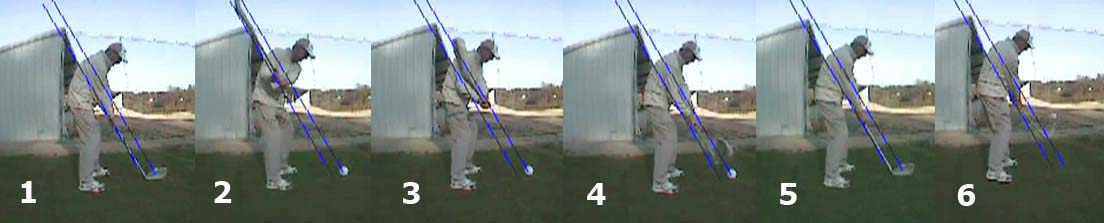
So, consider again this photo series of Yoda Luke' swing.
Image 1
At address, the clubshaft is on the elbow plane. The sweetspot in on sweetspot plane 2. The back of the left hand faces the target.
Image 2
Note what has happened to the left hand - it has rotated about 135 degrees from its address position (due to internal rotation of the left humerus and a small amount of left forearm pronation) and it it lies on the clubshaft plane at the end of an abbreviated backswing and the back of the flat left wrist/hand is parallel to the clubshaft plane, and also on the clubshaft plane. The clubshaft's hosel and clubface sweetspot have no choice - they also have to undergo that 135 degrees of rotation in unity with the back of the flat left wrist/hand. Because the hosel is in a straight line relationship with the clubshaft it doesn't shift planes during the backswing, so it remains on the elbow plane with the clubshaft. However, the sweetspot is on an extension that is a roughly at a 90 degree angle to the clubshaft. Therefore, the sweetspot rotates from sweetspot plane 2 (at address) to the clubshaft plane (by the end of the abbreviated backswing). When doing so, the sweetspot didn't rotate around the hosel - because there was no rotation around the Z axis. The sweetspot merely shifted positions from one plane to another plane because the flat left wrist/hand rotated about 135 degrees.
When the flat left wrist/hand is on the inclined plane (whatever the steepness of the inclined plane) at any time point between the top of the backswing and the third parallel, then the clubshaft and clubface must also be on that same plane. If the clubface sweetspot was on any other plane, then the clubshaft is off-plane.
From Yodas Luke's end-backswing position, the downswing should be a mirror image reversal of the backswing process. The biomechanical events causing the movement of the left hand from its end-backswing position to its impact position are the reverse of the backswing movement - they are external rotation of the left humerus and a small amount of left forearm supination. During this process the flat left wrist/hand undergoes a 135 degree rotation so that the back of the FLW/hand faces the target at impact. The clubshaft and clubface sweetspot must also undergo this rotation without there being any rotation about the Z axis. In this process, if the left hand is on the elbow plane at a point near the delivery position (because it was simply coming down the same inclined plane) and it is on the elbow plane at impact, then there was no plane shift when the clubshaft moved from the delivery position to impact. Therefore, the hosel will remain on that elbow plane during the release swivel phase. However, the clubface sweetspot has to rotate back to sweetspot plane 2 during its 135 degrees of rotation because the clubhead extension has a fixed near-right angle relationship to the end of the clubshaft. When the clubface sweetspot rotates from the elbow plane to sweetspot plane 2 during the release swivel phase of the downswing, it doesn't rotate around the hosel - because the sweetspot, hosel and left hand are all rotating at the same rpm.
You regard photo 2 as misleading because you thought that the hosel and sweetspot should be on the higher plane. Why did you think that it should happen if the flat left wrist/hand stayed on the lower plane? If the hosel and sweetspot were on the higher plane, then that would represent an off-plane motion of the clubshaft. Yodas Luke was not shifting planes during his backswing, so why should his clubshaft hosel and sweetspot shift planes?
You do not understand my viewpoint. I have never stated that the clubhead rotates around the hosel. I have repeatedly stated that there is no rotation around the Z axis (between PP#3 and the sweetspot) and therefore the clubhead sweetspot cannot rotate around the hosel (or vica versa). I have also repeatedly stated that that the clubface sweetspot and hosel have a fixed relationship with the back of the flat left wrist/hand and that they both rotate to exactly the same degree as the left hand. Jeff.
Jeff - what you describe is angled hinge action, an 'uncentered' motion that by the laws of physics (see chapter 2) is not as efficient as the ideal application, horizontal hinge and is, again, based on the laws of physics and the clubs design, at some level, controled steering. A fade is the natural result.
__________________
"Support the On Plane Swinging Force in Balance"
"we have no friends, we have no enemies, we have only teachers"
Simplicity buffs, see 5-0, 1-L, 2-0 A and B 10-2-B, 4-D, 6B-1D, 6-B-3-0-1, 6-C-1, 6-E-2
Why did Yodas Luke temporarily shift planes during the early downswing?
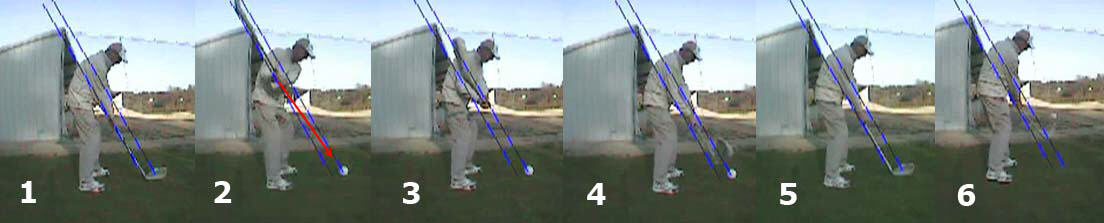
Consider this series of capture images of Yodas Luke's swing.
During the backswing, he didn't shift planes. He stayed on the elbow plane during his entire backswing. Therefore, if gets back to the same elbow plane by impact, then there should be no plane shift during the downswing.
However, he did shift planes temporarily. Note that his left hand (and therefore clubshaft) moved to a higher plane (sweetspot plane 2) in the early downswing - see image 3 - before he moved his left hand back down to the elbow plane by impact. That shifting of planes to a higher (steeper) plane and then back down to a lower (shallower) plane normally never happens in a "real" golf swing. That is equivalent to having a slight up-loop during the downswing. A golfer who has a plane shift in the downswing always shifts planes from a higher (steeper) plane to a lower (shallower) plane - and never the other way around.
So, why did it happen? I have a theory.
Normally, a good TGM-golfer directs PP#3 towards the ball-target line (base of the sweetspot plane) during the downswing - because he is trained to think that he must direct the orbiting sweetspot towards the ball-target line (base of the sweetspot plane). I think that Yodas Luke was thinking along those lines when he started his downswing - and the red arrow in image 2 represents the direction that he intended to direct PP#3. That caused his hands/clubshaft/sweetpot to go OTT - because they were directed at the base of the sweetspot plane. If he continued on that path then he would have hit the ball near the hosel of the club. He therefore had to make a "corrective" looping move a moment later to get the clubshaft back to the elbow plane by impact. Under usual circumstances this OTT problem doesn't happen. However, it becomes a "real" problem when the base of the clubshaft's inclined plane at impact is 9" away from the base of the sweetspot plane (because the actual distance between the hosel and the sweetspot is 9"), and a golfer aims his PP#3 at the sweetspot plane at the start of the downswing.




 Linear Mode


